The Installation

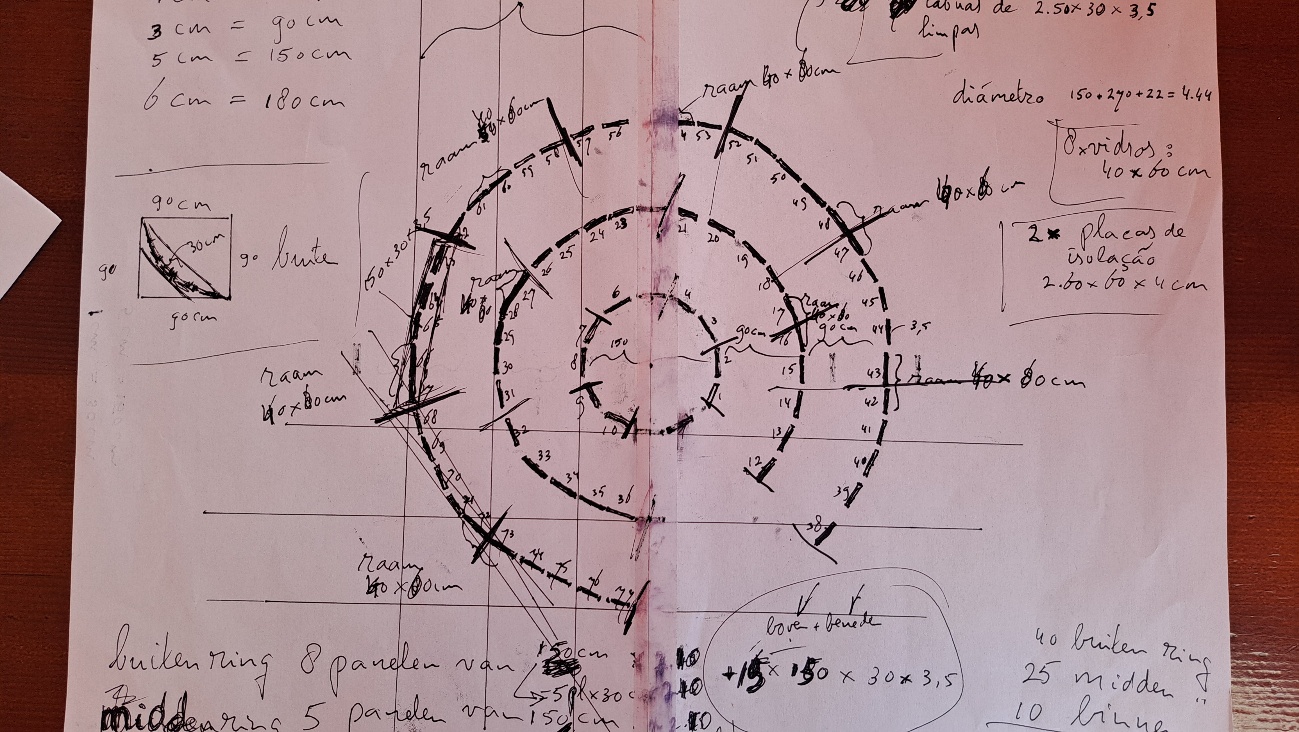
Pro-spektif consists of eighteen panels arranged in three concentric circles. Together, the panels create an environment through which visitors can move, look and discover different perspectives on a possible future.

The inner circle

The inner circle has a diameter of 1.5 metres and consists of five panels, each 60 centimetres wide and 2.4 metres high. One panel contains a window. Two panels represent world regions, one represents the oceans, and two remain open to new inspiration.

The central circle

The central circle has a diameter of 3.5 metres and consists of five panels, each 1.5 metres wide and 2.3 metres high. Two panels contain a window. Three panels represent world regions, one represents the oceans, and one remains open.

The outer circle

The outer circle has a diameter of 4.5 metres and consists of eight panels, each 1.5 metres wide and 2.2 metres high. Three panels contain a window. Three panels represent world regions, one represents the oceans, and four remain available for new ideas.

The open panels allow the installation to continue developing as new ideas, artworks and collaborations emerge.

An Open Collective

Pro-spektif is more than a visual installation. Music and light projections are intended to become part of the work, alongside text, interviews, films, performances, presentations and other forms of creative expression.

Members of Kollektif can contribute to the installation, but the project is also open to other interested people and organisations. They are invited to propose activities, contribute work or share their own ideas about the future.

The aim of this work is to generate discussion and stimulate positive ideas for the future.

Many changes in society will occur without direct human control. Some of the ideas imagined for 2260 may also conflict with the values and accepted norms of 2026. Pro-spektif creates a space in which these possibilities can be explored and discussed.

A Sustainable World

In 2026, the world had approximately 8.5 billion inhabitants. Pro-spektif imagines that after centuries shaped by pandemics, pollution, declining fertility, climate change, natural disasters, wars and political conflict, the world finally reaches a sustainable balance in the year 2260.

The imagined future is not presented as a prediction. It is a speculative scenario intended to encourage questions, discussion and alternative ideas about how society might develop.

The sections below provide a summary of the complete document. The full version remains available as a PDF and can continue to develop as the installation evolves.

Population & Environment

In the imagined world of 2260, the global population has reached a sustainable balance of 2.5 billion people. Decisions about where people live take into account climate change, access to food and energy, the attractiveness of cities and landscapes, and the space required for agriculture, animals and nature.

Before important decisions are made, referendums are organised using AI-assisted scenarios. These scenarios are reviewed by the population and are intended to support informed public decision-making.

The world is divided into urban areas, agricultural areas, natural parks accessible to people, and vast protected ecosystems with almost no human intervention. Approximately 60 million square kilometres of land are reserved for natural ecology, scientific research and carefully limited tourism.

Because fewer people inhabit the world, cities offer more space for work, art, music, sport and games. People can preserve and inhabit beautiful buildings while replacing unattractive structures. Churches and other monumental buildings become concert halls and exhibition spaces.

People may choose to live in historic cities or in the countryside, where there is also much more space.

Government

After worldwide crises, a world constitution is established in 2080. It introduces a new form of democracy focused on long-term policies and cooperation between the six world regions.

For every one million inhabitants, one decisionmaker is elected. With a population of 2.5 billion, this creates a worldwide body of 2,500 decisionmakers. They are elected for ten-year terms, with one vote available to every adult.

Their responsibilities include organising public wellbeing, coordinating between world regions, informing the population, gaining public support and selecting a world council of ninety members.

Decisionmakers are expected to demonstrate integrity, relevant knowledge and a proven commitment to the public interest. Important decisions require a two-thirds majority.

Worldwide and regional referendums are organised regularly. AI helps prepare different scenarios so people can compare possible outcomes before voting.

The world council is responsible for international police and military matters. It has sole authority to permit the use of arms, and there is only one global army.

Artificial Intelligence

In this imagined future, artificial intelligence combines centuries of scientific knowledge and information gathered from billions of people. It can process relationships and patterns on a scale that no individual human mind could achieve.

AI supports scientific research, healthcare, environmental planning, energy efficiency and public decision-making. It helps solve medical and social problems by combining knowledge about genes, peptides, hormones and human development.

At the same time, AI creates serious risks. It gives a minority of clever and wealthy people new possibilities to influence and manipulate the population. New forms of democracy are therefore needed to empower people.

In the decades after 2026, scientific and environmental facts became increasingly politicised. In the imagined history of Pro-spektif, international agreements were later introduced to reduce political control over AI and to strengthen fact-based public decision-making.

AI and robotics eventually take over many forms of repetitive labour. As a result, people have more time for art, music, sport, education, games, relationships and other personal or collective activities.

Energy

Energy in 2260 is produced entirely through sustainable sources, including nuclear fusion, solar power, wind, hydroelectric power and geothermal energy.

AI continuously balances the different energy sources with the needs of populated areas. This makes the worldwide energy system more efficient and reduces energy costs to approximately twenty percent of their level in 2026.

In this imagined history, nuclear fusion first becomes cheaper than wind energy in 2101. Waste from older nuclear reactors is reused as fuel for later fusion reactors.

Food

Food is produced without chemicals that damage human health or the environment. Agricultural areas and natural spaces for livestock are organised around populated regions.

Animals live in natural parks under conditions that resemble their normal behaviour as closely as possible. When animals are killed for food, this is done according to animal-friendly methods informed by scientific research.

AI-assisted systems help individuals understand which foods are most suitable for their health at a particular moment.

Nature

Biodiversity is protected by the world constitution. Approximately forty percent of the global land surface consists of large natural parks where complete ecosystems can develop without human interference.

Scientific research and limited observation remain possible, but human access is carefully controlled.

Another twenty percent of the land surface consists of natural and agricultural areas surrounding populated regions. These areas are open to the public and provide space in which animals can live more naturally.

AI-assisted research develops new methods for removing poisonous materials from water and soil. Half of the oceans are protected from human activity, apart from scientific research. In the remaining half, pollution, transport and underwater noise are strictly limited.

By 2260, the quality of both air and water has improved dramatically, supported by environmental restoration and advanced filtration systems.

Society

The world constitution guarantees equal basic rights, independent courts and freedom of the press.

Primary and higher education are free. AI helps connect education to the abilities and interests of each individual. Universities, medical care and social care are publicly financed.

Families with one or two children receive support for childcare, education, healthcare and income lost during pregnancy and the child's first year.

Advances in AI, genetics, hormones and medical science prevent or treat many conditions that were common in 2026. People live, on average, twenty years longer.

With fewer people, less competition for resources and a political system designed to prevent war, society experiences a greater sense of safety. Poverty has disappeared, crime has fallen dramatically, and trust between people has increased.

Scientific developments also make it possible to reproduce and analyse odours. Scents are used for enjoyment, social experiences and medical diagnosis.

International law is restored as a central principle of government. The world council becomes responsible for its continued development after consultation with the population.

Economy

AI and robotics make production far more efficient. Many tasks that required human labour in 2026 are automated, leaving people with more time for creative, social and personal activities.

Because human labour is scarce, it is considered valuable. Organisations include employee boards with consultation rights over important decisions.

The world uses one currency: the Multiplier, commonly known as the MP. A shared currency reduces financial, administrative and international trade costs.

Every person receives a basic income sufficient to cover the essential costs of life. Additional income can be earned through work, while maximum salaries are linked to the basic income and to a person's contribution to their organisation and society.

Energy and housing are inexpensive. Many unnecessary or unattractive buildings have been demolished and their materials reused. Former urban neighbourhoods have been transformed into large parks that improve the climate of cities and reduce temperatures on hot days.

In the imagined history, a major operation in 2066 clears obsolete satellites and other debris from the space surrounding Earth. Rare metals are later extracted from the Moon, where data centres and energy facilities are also established.

Read the Complete Document

This page presents a summary of the ideas behind Pro-spektif. The complete document, A Sustainable World, contains the extended vision and supporting details for the installation.

The document is intended to remain open to development. New ideas and revisions can be added as Pro-spektif continues to evolve.

The Six World Regions

The complete vision also explores how population, nature and decision-making might be organised across six world regions: Asia, Oceania, Africa, North America, South America and Europe.

This part of the online project is still under development. It will be expanded as new installation panels, images and ideas become available.

New panels and contributions will be added as the installation evolves.